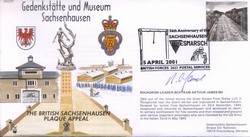
Cover produced to raise funds for the British Sachsenhausen Plaque Appeal. Sachsenhausen was one of the German Death Camps during WWII and therefore little is probably known unless you research the subject quite thoroughly. The covers were produced in 2001 showing the Sachsenhausen gate house, barracks and memorial with a special BFPS 2623 postmark for the 56th Anniversary of Sachsenhausen Todesmarsch 5 April 2001.
Signed by Squadron Leader Bertam Arthur James MC
200 Numbered and Certified on reverse
Cover size 210mm x 120mm
Please note stamp on cover may vary to that show on scanned image.
Jimmy James was a member of Bomber Command and having been shot down and taken POW he was sent to Stalag Luft III, where he took part in the Great Escape on the 24th March 1944 but was recaptured near the Czech border and sent to Sachenhausen under the sentence of death along with three other members who took part in the Great Escape. At Sachsenhausen an Escape Committee was formed and another tunnel was dug and in September 1944 they escaped from Sachsenhausen, only to be recaptured some days later. He was sent back to Sachenhausen and due to be executed but luck intervened and he was liberated by the US Army in May 1945.
The Sachsenhausen Concentration Camp
The Sachsenhausen Concentration Camp was built in the summer of 1936 by concentration camp prisoners from the Emsland camps. It was the first new camp to be established after Reichsfuhrer-SS Heinrich Himmler was appointed Chief of the German Police in 1936. The design of the grounds was conceived by the SS architects as the ideal concentration camp setting, giving architectural expression to the SS worldview, and symbolically subjugating the prisoners to the absolute power of the SS. As a model for other camps, and in view of its location just outside the Reich capital, Sachsenhausen acquired a special role in the National Socialist concentration camp system. This was reinforced in 1938 when the Concentration Camp Inspection Office, the administrative headquarters for all concentration camps within the German sphere of influence, was transferred from Berlin to Oranienburg.
More than 200,000 people were imprisoned in the Sachsenhausen Concentration Camp between 1936 and 1945. At first the prisoners were mostly political opponents of the Nazi regime. However, increasing numbers of members of groups defined by the National Socialists as racially or biologically inferior were later included. By 1939 large numbers of citizens from the occupied European states arrived. Tens of thousands of people died of starvation, disease, forced labor and mistreatment, or were victims of the systematic extermination operations of the SS. Thousands of other prisoners died during the death marches following the evacuation of the camp at the end of April 1945. Approximately 3,000 sick prisoners, along with the doctors and nurses who had stayed behind in the camp, were liberated by the Russian and Polish troops of the Red Army.